















You know that feeling around two or three o’clock in the afternoon. You’re finalising a spreadsheet, replying to yet another email or scrolling through social media, when suddenly your eyes start to sting. You start blinking more quickly, the text on the screen becomes slightly blurred, and it feels as though someone has sprinkled fine sand under your eyelids.
Your hand automatically reaches for the bottle of artificial tears. You put a few drops in, feel relief for ten minutes, and then the whole cycle starts all over again. Perhaps something else might help you!
If you spend most of your working day in front of screens, you probably experience this scenario regularly. However, the problem usually isn’t that your eyes aren’t producing enough tears. The real culprit lies elsewhere – your tears evaporate too quickly.
What effect does a screen have on our eyesight?
During a normal conversation, we blink about 15 to 20 times a minute. Each blink acts like a windscreen wiper on a car. It spreads a fresh layer of tears across the surface of the cornea, which protects, nourishes and moisturises the eye.
However, when we stare at a monitor, laptop or smartphone, our blink rate drops to a third – sometimes to just 5 to 7 times per minute. What’s more, we don’t blink fully; often, our eyelids don’t even touch. The eye remains exposed to the dry air from the air conditioning or a radiator for several seconds, and the tear film begins to break down.
A tear is not just salty water: The key role of the lipid layer
The tear film consists of three precisely balanced layers:
Mucin (mucous) layer: it lies directly against the eye and ensures that tears adhere to it at all.
Water layer: this forms the thickest central part, which moisturises and provides nutrients.
Lipid (fat) layer: a thin film of oil on the very surface, produced by the tiny Meibomian glands at the edges of the eyelids.
It is precisely this lipid layer that is essential for office workers. It acts like a protective lid on a saucepan. If this oily film is of poor quality or too thin, the watery component of tears will evaporate from the cornea immediately.
And here’s why ordinary eye drops often fail: most artificial tears simply replenish water. If the eye lacks a functioning lipid barrier, the water applied evaporates within a few minutes and the dryness returns.
Omega-3 fatty acids: A solution that repairs tears from within
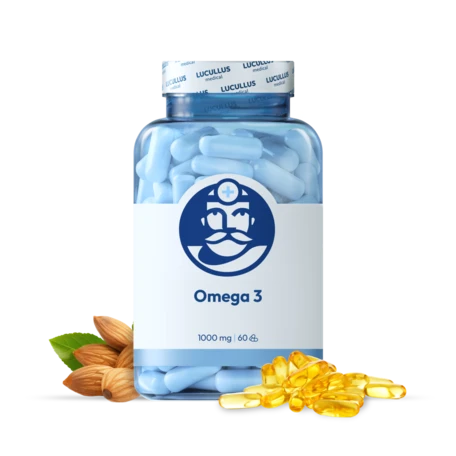
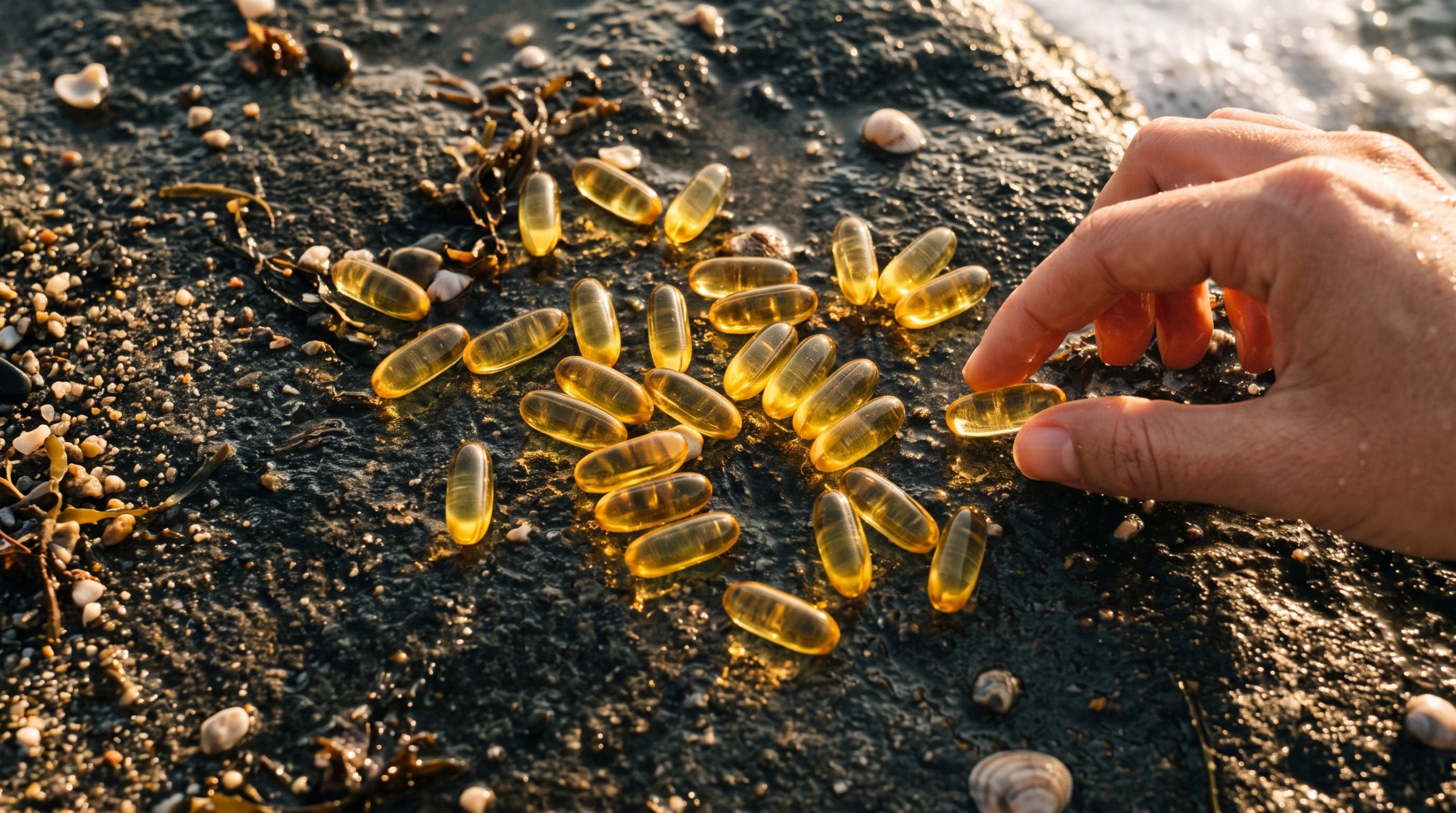
Rather than constantly putting out fires from the outside, it makes far more sense to improve the quality of the tears themselves. This is precisely what omega-3 fatty acids do, specifically the forms EPA (eicosapentaenoic acid) and DHA (docosahexaenoic acid).
1. They improve the viscosity of the lipid film
The Meibomian glands require the right types of fats to produce a protective film. If there is a lack of omega-3 and an excess of common saturated fats in the diet, their secretion becomes too thick and waxy – the glands become blocked and fail to form a smooth film. Omega-3s help keep this secretion fluid and clear, so that with every blink it spreads evenly across the entire eye.
2. They reduce micro-inflammation
Chronic dry eye is associated with redness and inflammation of the surface of the eye and the edges of the eyelids. EPA and DHA are known for their powerful anti-inflammatory effects. They reduce the levels of inflammatory markers directly in the tears, which provides relief from chronic stinging and burning.
3. They reduce dependence on drops
A regular intake of omega-3 prolongs what is known as the tear break-up time (TBUT). This means that the tear film remains intact on the eye for significantly longer, even when you’re engrossed in your work and blinking less.

How to incorporate them into your daily routine
For omega-3 supplementation to have a measurable effect on eyesight, it is worth following a few guidelines:
Focus on the right forms: The body needs EPA and DHA. The plant-based form ALA (from flax or chia seeds) is converted into these only to a very small extent (often less than 5 per cent). Opt for a high-quality fish oil or a vegan oil made from seaweed.
Dosage: For dry eye syndrome, a combined daily dose of around 1,000 to 1,500 mg of EPA + DHA has been shown to be effective in studies. Give it time: Unlike eye drops, which provide immediate relief, omega-3s work at a cellular level. It takes approximately 4 to 8 weeks for the composition of the lipid layer in your tears to stabilise, and you’ll suddenly realise that your eyes have stopped bothering you in the afternoon.
Three quick habits to help you do this
Getting enough healthy fats is essential, but a comprehensive approach is best for your eyes whilst working:
The 20-20-20 rule: Every 20 minutes, look at an object at least 6 metres (20 feet) away for 20 seconds and consciously close your eyelids completely several times.
Monitor position: The top of the screen should be at eye level or slightly below it. When you look slightly downwards, your pupils are narrower and the surface area of the eye exposed to light is smaller.
Be mindful of air flow: Check that your air conditioning or fan isn’t blowing directly into your face.
Stop just dealing with the symptoms and focus on the cause. A high-quality source of omega-3 will provide your eyes with a natural protective shield, enabling you to get through a working day in front of a screen without constant eye strain, tiredness or having to reach for eye drops.