















When we hear the term ‘healthy fats’, most of us automatically think of omega-3 fatty acids. However, very few people realise that their main role is not simply to ‘be healthy’, but to put out the fire that we ourselves start in our bodies every day. That fire is called the modern diet, and its main source is its equally well-known relatives – omega-6 fatty acids.
The evolutionary agreement that we have broken
Our bodies have evolved over hundreds of thousands of years on a diet in which two groups of essential fats – omega-3 and omega-6 – were in almost perfect balance. Whilst omega-6s are responsible for triggering inflammatory responses in the body (which is brilliant when you cut yourself and the body needs to immediately protect the wound from infection), omega-3s act like firefighters, switching off this inflammation once their job is done.
Throughout evolution, this ratio fluctuated roughly between 1:1 and 1:4 in favour of omega-6. Both types were equally represented and the body functioned in harmony. The problem only arose in the last century with the advent of industrial food production.
The invasion of sunflower oil and ultra-processed foods
For the average European today, this ratio is skewed to 1:15, and often as high as 1:20. This means that for every ‘firefighter’ (omega-3), there are twenty ‘arsonists’ (omega-6). How did this come about?
- cheap vegetable oils: Sunflower, maize and soya oils have become staples of modern kitchens and the food industry. They are cheap, stable and extremely rich in omega-6.
- ultra-processed foods: crisps, shop-bought pastries, biscuits, ready meals, sauces and fast food – almost everything with a long shelf life and a crispy texture is prepared using refined vegetable oils.
- changes to animal feed: Yes, this change goes that far, because even meat and eggs no longer have the same nutritional composition as they used to. Whilst a cow grazing on grass produces milk and meat with a natural omega-3 content, cattle fed on maize and soya once again accumulate only omega-6.
The result of this silent change is chronic micro-inflammation. It doesn’t hurt as much as a sprained ankle, but over time it wears down the immune system, impairs recovery, contributes to fatigue and skin problems, and may increase the risk of cardiovascular disease.
Why is it not enough just to ‘eat more seeds’?
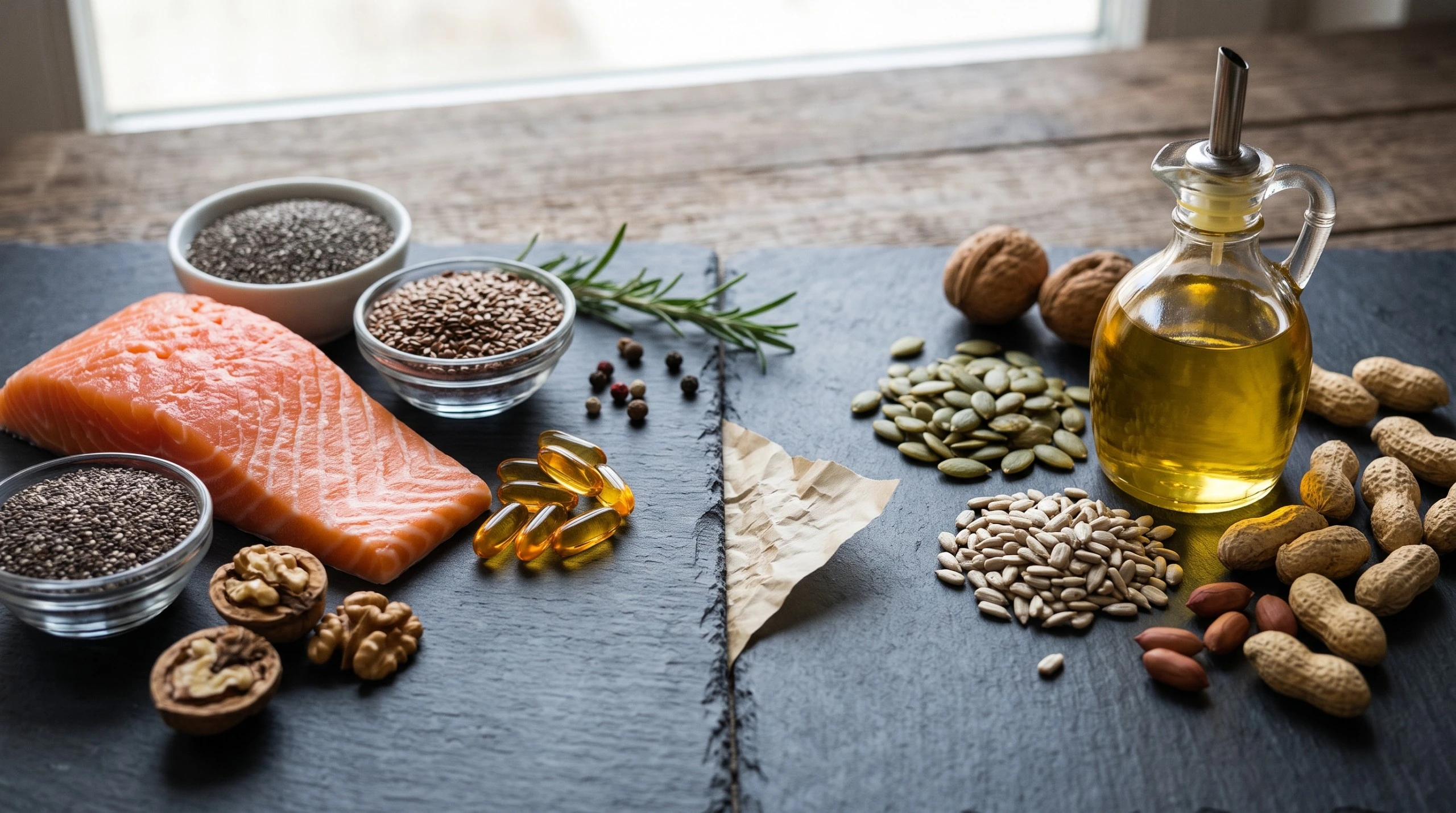
When people try to correct this imbalance, they often turn to linseeds or walnuts. Whilst these do contain a plant-based form of omega-3 (alpha-linolenic acid – ALA), the human body is only able to convert it into the active forms (EPA and DHA), which actually reduce inflammation and nourish the brain, with very low efficiency (usually less than 5–10 per cent).
The real ‘firefighters’ – EPA and DHA – are found almost exclusively in oily sea fish (salmon, mackerel, sardines) and in marine microalgae. As most of us do not eat good-quality oily fish two or three times a week, the deficiency is becoming more severe.
How can you restore your body’s balance?
The aim is not to demonise omega-6 fatty acids entirely, as the body needs them. The key is to correct the imbalance in two simple steps:
1. Cut down on omega-6: Limit frying in sunflower oil (replace it with olive oil, butter or ghee) and check the ingredients list on packaged foods. The fewer ultra-processed foods you eat, the fewer hidden omega-6s there will be.
2. Boost your intake with high-quality omega-3s: If you don’t regularly eat wild-caught sea fish, a high-quality fish oil or microalgae supplement is the easiest way to make up for this shortfall.

Our genes have remained virtually unchanged over the last ten thousand years, yet the contents of our plates are beyond recognition. Taking omega-3 fatty acid supplements is therefore not just another modern wellness trend, but an effort to restore the body to the conditions for which it was designed. You don’t need to overhaul your entire diet overnight – simply swap the oil in your frying pan, cut down on processed foods, and give your cells what they need to function calmly, rather than in a constant state of alert.