















By the time a joint starts to ache, it’s already too late for prevention – you’re merely putting out a fire that’s been smouldering inside your body for months or years. Joint nutrition isn’t a painkiller, but rather a building block – and you wouldn’t start repairing your house only when the roof has already fallen on your head.

Why doesn’t cartilage hurt when it’s being destroyed?
To understand why waiting for the pain to set in is a huge mistake, we need to look at how a joint works.
Articular cartilage is a unique tissue that absorbs shocks and ensures that bones do not rub against one another. However, it has one treacherous characteristic: it contains neither nerve endings nor blood vessels.
In practice, this means two things:
Cartilage doesn’t warn you. It can gradually wear away and thin out over many years without you feeling a thing. The pain only sets in when the cartilage has deteriorated to such an extent that it begins to irritate the surrounding tissues, the joint capsule or the bone itself.It regenerates extremely slowly. As there are no blood vessels in the cartilage, nutrients do not reach it directly via the bloodstream, but only by being ‘drawn in’ from the synovial fluid during movement. It therefore requires a long-term and regular supply of building blocks.
Joint nutrition is not a painkiller
Many people take joint supplements on Mondays, only to be disappointed on Fridays that their knee still hurts. This highlights a misunderstanding of what these supplements actually do.
High-quality joint nutrition (containing substances such as type II collagen, glucosamine, chondroitin and MSM) does not provide immediate pain relief. It works by supplying the building blocks – the bricks and mortar. The body gradually stores these substances and uses them to nourish and protect cartilage, tendons and ligaments. To feel a real difference, you need to take it for at least 2 to 3 months continuously.
Who should take it as a preventative measure, even if they aren’t in any pain?
You don’t have to be a top-level athlete for your joints to take a beating. A preventative course of treatment (ideally twice a year for 2–3 months) makes a world of difference if you fall into any of the following groups:
- you exercise regularly: particularly when running, doing strength training, playing tennis, football or hiking (walking downhill, in particular, puts a lot of strain on the knees)
- you have a sedentary job: Paradoxically, a lack of exercise is also harmful to your joints. When you sit for long periods, the cartilage is not lubricated and ‘starves’
- if you have a physically demanding job or are overweight: every extra kilogram puts several times more pressure on your knee and hip joints when walking
- You’re in your thirties: The body’s natural production of collagen begins to decline from around the age of 25, and this decline accelerates once you reach your thirties

What can we take away from this?
Don’t wait for that first twinge in your knee or morning stiffness. Think of joint supplements in the same way as an oil change for your car – you do it so that your car can keep running without any major problems.
What to look for when choosing:
Collagen (particularly types I and II): A fundamental structural protein. Look for hydrolysed collagen (peptides), which is best absorbed.
Glucosamine and chondroitin: Substances that occur naturally in cartilage and help to bind water and maintain its elasticity.
MSM (methylsulfonylmethane): An organic sulphur compound that helps to reduce inflammation and promotes collagen production.P
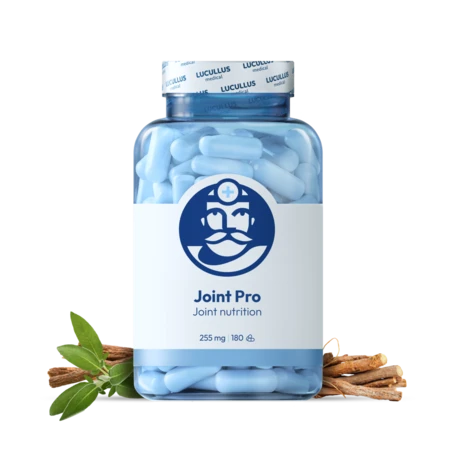
It is precisely on this principle of comprehensiveness that we have based our premium joint supplement, Join Pro. Instead of a standard single-ingredient supplement, it contains a powerful triple combination of glucosamine, chondroitin and shark cartilage, supplemented with MSM and a unique blend of herbal extracts (devil’s claw, ginger, reishi, wild yam and liquorice). Thanks to the capsule form, each dose provides a generous amount of active ingredients that ensure the necessary nutrition and long-term comfort for your joints.