















Imagine you’re building a house. You’ve ordered the very best bricks and hired a whole team of workers, but there’s no site manager on the building site. The workers just pile the bricks wherever it suits them – right on the driveway. Instead of solid walls, you suddenly end up with something that bears no resemblance whatsoever to the house you had planned.

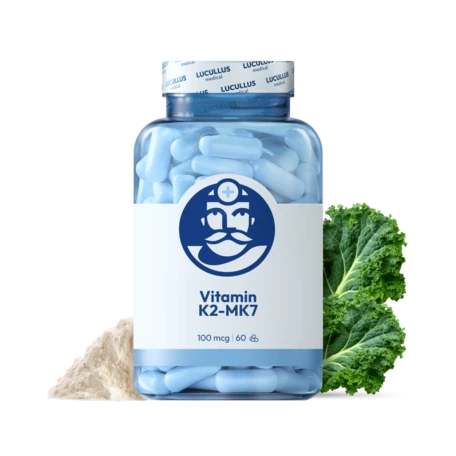
This is exactly what happens in your body when you take calcium and vitamin D, but are missing one crucial element. That element is vitamin K2-MK7. This long-overlooked vitamin has come to the forefront of scientific attention in recent years, and for very good reason. It is this vitamin that regulates calcium and determines how it is utilised in our bodies.
Calcium guides the way
Calcium is absolutely essential for our bodies. We need it for strong bones and teeth. The problem is that calcium on its own in the bloodstream is ‘blind’. It doesn’t know where to go. This is where vitamin K2-MK7 comes to the rescue. Its main role in the body is to activate a specific protein called osteocalcin. This protein acts like a magnet, literally capturing the calcium and embedding it exactly where it belongs – directly into the structure of our bones and teeth. Without sufficient K2, this protein remains inactive and calcium does not reach the bones in the quantities we need.
Protector of healthy blood vessels
If calcium doesn’t end up in the bones, where does it go? Unfortunately, it tends to build up in soft tissues, particularly in the walls of blood vessels and arteries. This process is called vascular calcification and is one of the main risk factors for cardiovascular disease, as it causes the arteries to harden and become blocked.
Vitamin K2-MK7 is your heart’s best friend, as it activates another important protein, Matrix Gla Protein (MGP).
MGP acts as a ‘cleanser’ that travels through the blood vessels, binding to and removing excess calcium.As a result, the arteries retain their natural elasticity, which significantly reduces the risk of high blood pressure and heart attack.

Why is the ‘MK-7’ model the absolute best?
You may be wondering why experts recommend the specific form MK-7 (menaquinone-7) rather than other types of vitamin K. The answer lies in how long this vitamin remains active in the body:
Extreme longevity: Whilst other forms (such as K1 from spinach or K2-MK4 from animal fats) disappear from your bloodstream after just a few hours, MK-7 remains active there for up to 72 hours. Natural effectiveness: The highest-quality MK-7 is obtained through natural fermentation, often from a traditional Japanese soy-based dish called nattō. Just one small capsule a day is enough to maintain a stable and high level of this protective compound in your blood throughout the day and night.
The perfect pairing with vitamin D3
In the world of nutrition, vitamins D3 and K2-MK7 are a bit like tomatoes and basil in gastronomy. They work brilliantly when taken together. But why? Vitamin D3’s role is to ensure that calcium from food is actually absorbed from the intestines into the bloodstream. However, if you take high doses of vitamin D3 on its own, your body will start pumping huge amounts of calcium into your bloodstream. If you’re lacking K2-MK7 at that point, this calcium will start to build up in your kidneys and blood vessels, which in the long term can do more harm than good.
That is why vitamin K2-MK7 and vitamin D3 work together to ensure our bodies derive the greatest benefit from them. Vitamin D3 opens the door and allows calcium into the bloodstream, whilst vitamin K2-MK7 ensures that the calcium reaches the bones and teeth. So, if you’re thinking about supporting your immune system, bones or heart, don’t forget that to make the most of ‘sunshine’ vitamin D3, you also need this unassuming but all the more powerful helper – vitamin K2-MK7.