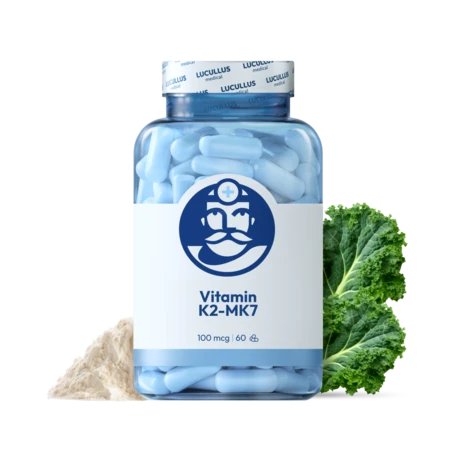
















Most winter articles about vitamins sound as if they’ve been copied and pasted: ‘The sun doesn’t shine in winter, so take D3 for your immunity and K2 for your bones.’ It’s true, but it’s only half the story. If you take vitamin D3 in higher doses without the correct form of vitamin K2 – specifically K2 MK-7 (menaquinone-7) – your body may derive almost no benefit from it, or you may even be setting yourself up for a silent problem in your blood vessels in the long term.

Let’s look at the combination of D3 and K2 MK-7 through the lens of biochemical logistics, examining the differences between the various forms of these molecules and the details that determine whether this winter supplement actually works.
Nutrient logistics
Imagine calcium as a building material that has just arrived at your front door. Vitamin D3 acts as a warehouse worker who opens the gate (the intestinal wall) and unloads the calcium directly into the bloodstream. Thanks to D3, the absorption of calcium from your diet increases many times over. The problem arises when there is suddenly an excess of calcium circulating in the blood, but there is nowhere for it to go. This is because vitamin D3 does not decide where the calcium goes.
This is where vitamin K2, in the form of MK-7, comes into play. It activates two key proteins:
Osteocalcin: Acts like a magnet, drawing calcium directly into the bone matrix and teeth. MGP (Matrix Gla Protein): Is the most potent known natural inhibitor of vascular calcification. It literally ‘sweeps’ calcium out of blood vessel walls and soft tissues, where it would otherwise cause them to harden and lose their elasticity.
Why choose the K2 MK-7 in particular?
Vitamin K2 is not just a single substance – it is a whole group of subtypes designated by the abbreviation MK (menaquinone), with a number corresponding to the length of the chemical chain. In dietary supplements, you will mainly come across two forms, but in practice they behave quite differently:
MK-4 (menaquinone-4)
- often synthetic in origin
- it breaks down in the blood within 1–2 hours
- It is recommended to take this form several times a day; however, its effectiveness wears off more quickly than it has time to become fully active in the blood vessels
MK-7 (menaquinone-7)
- Today, dietary supplements containing this form are produced in two different ways: by natural fermentation and by chemical synthesis
- it takes longer to break down in the blood – up to 72 hours, to be precise – which means that a single daily dose is sufficient
Vitamin D3 is structurally similar to hormones, and some studies and practical experience suggest that, in more sensitive individuals, taking it in the evening may slightly suppress the production of melatonin (the sleep hormone). Ideally, a combination of D3 and K2 MK-7 should be taken with breakfast or lunch that contains fats, as both vitamins are fat-soluble.
Why can’t you simply ‘get enough’ of these two from your diet in winter?
Many people rely on a varied diet to make up for their winter deficiency. However, when it comes to the combination of D3 and K2 MK-7, the maths of nutrition is rather unforgiving:
The winter vitamin D3 trap: Whilst in summer the body can produce thousands of international units of D3 itself after just a short spell in the sun, in winter food is only a poor substitute. To obtain a dose from your diet comparable to standard winter supplementation, you would have to eat a large portion of fatty wild salmon or drink several litres of fortified milk almost every day.
K2 MK-7 is virtually absent from the European diet: Whilst vitamin K1 is found in leafy green vegetables (spinach, kale) and the MK-4 form in smaller quantities in egg yolks or butter, the MK-7 form is produced almost exclusively through bacterial fermentation. By far the richest natural source of MK-7 is the traditional Japanese fermented soya beans known as natto, which have a distinctive taste and smell and are rarely eaten in our part of the world. Common European cheeses (e.g. Gouda or Emmental) contain vitamin K2 and are one of the best sources of this vitamin; however, they contain MK-7 in smaller quantities and consist primarily of longer menachinones (MK-8 and MK-9).

Although the combination of D3 and K2 MK-7 is safe and beneficial for most healthy people, there is one exception. People taking blood-thinning medication (particularly warfarin) should not start taking vitamin K2 without consulting their doctor, as it could reduce the effectiveness of the medication.
When it comes to looking after our health, we often focus only on what we feel in the moment – for example, whether we catch a cold in January or whether we have enough energy. However, the combination of D3 and K2 MK-7 works in two areas at once: whilst ‘vitamin D’ provides a protective shield during the chilly months, the MK-7 form quietly safeguards the elasticity of your blood vessels and bone density for decades to come. So, in winter, with just one morning ritual, you’re not only looking after yourself for the current season, but also ensuring your body is in the best possible condition a few years down the line.