















Magnesium is a miracle mineral. It improves sleep, relaxes muscles, reduces stress and helps produce energy. The problem arises when you realise that it comes in several forms – citrate, oxide, malate and bisglycinate. Which one should you choose? If you pick the wrong one, not only will it not help you, but it may cause unpleasant diarrhoea or, conversely, keep you awake at night.

Magnesium is often referred to as the ‘relaxation mineral’ and acts as a natural calming agent for our brain and body. However, it is not a sleeping aid in the strict sense of the word; rather, it creates the ideal biological conditions in the body to help you fall asleep peacefully.
How does magnesium affect sleep?
It activates GABA receptors: GABA (gamma-aminobutyric acid) is an important neurotransmitter in the brain, whose role is to slow down and gradually calm nervous activity. Magnesium binds to these receptors, thereby literally helping to ‘switch off’ racing thoughts and calm the nervous system.
Relaxes the muscles: Magnesium works in conjunction with calcium in the body. Whilst calcium causes muscles to contract, magnesium acts as its natural antagonist and helps muscle fibres to relax. It relieves physical tension after a long day.
It supports melatonin production: Magnesium is essential for the production of this sleep hormone, which regulates our internal sleep-wake cycle.
Reduces stress: It helps to lower cortisol levels (the stress hormone) in the body, which means we don’t feel so tense before going to bed.
It is the form that matters
Not all magnesium is the same. The difference lies in the molecule to which the magnesium in the supplement is bound. This determines where and how it will act in the body:
For a good night’s sleep, opt for bisglycinate: this is magnesium bound to the amino acid glycine. Glycine itself has powerful calming effects on the brain and even slightly lowers body temperature, which is one of the signals to the body that it is time to go to sleep. This form is also very well absorbed and does not irritate the stomach.
What to avoid in the evening: Magnesium malate (bound to malic acid) is often taken in the morning as it aids in the production of cellular energy and could keep you awake. Magnesium oxide or citrate, on the other hand, can have a laxative effect at higher doses, which is certainly not ideal before bedtime. The laxative effect of magnesium is caused by a process known as the osmotic effect.
How does the osmotic effect work in the intestines?
A magnet for water: If you take a form of magnesium that has low bioavailability (your body cannot absorb it into the bloodstream), a large proportion of this mineral will remain in your digestive tract.
It draws in fluids: Unabsorbed magnesium in the large intestine begins to bind water from the surrounding tissues.
Stimulates bowel movements: The increased volume of water in the bowels softens the stools and stretches the intestinal walls. This triggers contractions, which your body interprets as an immediate signal to have a bowel movement.
Which forms of magnesium should you be wary of?
It depends mainly on the compound to which the magnesium is bound. If you’re looking for a dietary supplement for your muscles or nerves and don’t want to risk diarrhoea, watch out for these forms:
Magnesium oxide: This is the most common culprit. It is the cheapest form, found in ordinary effervescent tablets or cheap supplements. It is very poorly absorbed; a large amount remains in the intestines and acts as a powerful laxative.
Magnesium citrate: Although this form is absorbed much more effectively than magnesium oxide and is excellent for relieving cramps, it has natural laxative effects. In medicine, higher doses of citrate are even used specifically to empty the bowels prior to a colonoscopy.
Magnesium sulphate (Epsom salt): When taken orally (as a drink), it acts as a very strong and fast-acting laxative. However, it is more commonly used as a bath salt.

So, to sum up, remember these three key points:
- cheap magnesium oxide is poorly absorbed and acts more as a laxative
- Magnesium bisglycinate is the best choice for evening relaxation and sleep
- Magnesium malate is the ideal choice for morning energy and muscle support
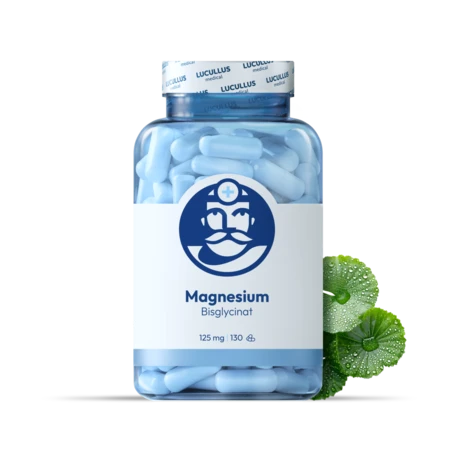
With a focus on quality, Dr LUCULLUS has therefore developed the Magnesium (Bisglycinate) dietary supplement, which supports the proper functioning of the nervous system, the muscles and the heart. If you are looking for high-quality support for your mental wellbeing that won’t put unnecessary strain on your digestion, Dr LUCULLUS Magnesium is the right choice.
Investing in the right form of magnesium is an investment in your own health and wellbeing. Your body needs this essential mineral, whether from your diet or in the form of a high-quality supplement. Now you know how to get it into your system so that it works and isn’t wasted. Treat yourself to high-quality dietary supplements from Dr. LUCULLUS, which will provide you with guaranteed support.