















What would our digestion look like under a microscope? Imagine eating a delicious plate of spaghetti with cheese sauce. The great taste is just the beginning… the real magic only begins in your digestive tract. That’s where the specialists spring into action: digestive enzymes. These ‘mini-machines’ are responsible for ensuring your body can extract everything it needs from food: energy, building blocks and nutrients. Without them, you’d get almost nothing from your food, smoothies or meat. There are several digestive enzymes, and each has a specific role:

Amylase begins to work as early as in the mouth, where it breaks down starches (e.g. from pasta) into simple sugars. Protease in the stomach and small intestine breaks down proteins (e.g. from cheese) into amino acids, which build muscles. Lipase breaks down fats into fatty acids, which the body uses as fuel. Lactase helps digest lactose from dairy products; if you lack it, you’ll experience the familiar ‘stomach upset’. Cellulase, although not naturally produced by the body, helps break down fibre from plants. Maltase and sucrase break down sugars (maltose, sucrose) into glucose and fructose, which the body uses as a quick source of energy.
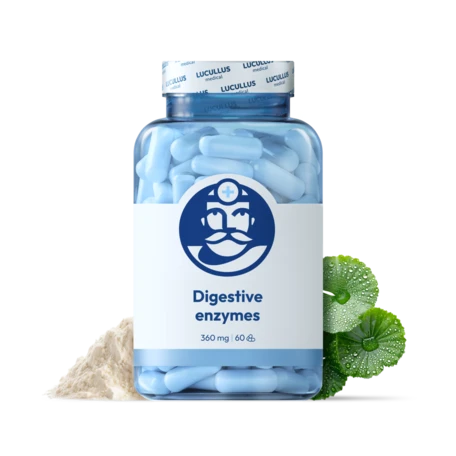
These enzymes work as a perfectly coordinated team; if even one member is missing, it can have consequences: bloating, fatigue, diarrhoea or a lack of nutrients. In an ideal world, our bodies would manage everything on their own, but let’s be honest… that’s not always the case. Especially when we see a meal we love and can’t resist it even when we’re ‘full’ (and I’m not talking about spaghetti here). And since enzyme production naturally declines with age, as well as due to stress, pancreatic disorders, coeliac disease, irritable bowel syndrome, or following a course of antibiotics. Dr. Lucullus® digestive enzymes can be a great help in these situations. Several studies have shown that taking enzyme supplements leads to a reduction in bloating, reduces cramps and the feeling of fullness after meals, improves nutrient absorption, provides relief from lactose intolerance, and reduces digestive problems following fatty meals. Research published in *Clinical and Translational Gastroenterology* has confirmed that enzyme supplementation helps patients with digestive disorders reduce their symptoms by up to 50 % within just 4 weeks. However, it is important that the dietary supplement contains several types of enzymes, not just one; it is precisely combinations such as amylase + protease + lipase + lactase + cellulase that ensure comprehensive digestion. Another important factor is that the enzymes must be active (meaning they have sufficient enzymatic potency), and plant-based enzymes are, of course, ideal as they are gentler on the stomach.

Because the aim is to digest food wisely, not with difficulty. After all, digestion doesn’t have to be a struggle… even if you fancy a steak 🥩, for example, or steak tartare. Or (like me) you just can’t resist a sweet dessert 🧁.
Thanks to digestive enzymes – whether your body produces them naturally or you take them as supplements – your body can get the most out of every mouthful. Digestive enzyme supplements are backed by clinical and experimental evidence. If you feel tired or bloated after a meal, or if you suffer from food intolerances, these little helpers – digestive enzymes – might just be the answer. When should you take them?
"When your tummy is playing up" – bloating, wind or constipation are a more frequent occurrence than you’d like.
‘If milk isn’t your friend’ – or other foods – can cause digestive problems.
"When you want to speed up fat burning" and give your metabolism a small but powerful boost.
"If you want to get more out of your food" – more nutrients, more energy, more well-being.