















You may have noticed this in a chemist’s or on an online shop too: standard vitamin C for a few euros, and right next to it the same vitamin labelled ‘liposomal’ for three to four times the price.

Our initial reaction is often one of scepticism — is this just another way of fleecing us for money with fancy packaging, or does this technology actually make sense? Let’s take a look at exactly what’s inside these little capsules or liquids, and why so many doctors and biohackers swear by them.
What exactly is a liposome?
The word ‘liposome’ sounds rather technical, but the principle is ingeniously simple and inspired by nature itself.
A liposome is a microscopic sphere (vesicle) whose outer layer consists of a double layer of phospholipids — precisely the same fat molecules from which the cell membranes in our bodies are made.
Put simply: a liposome acts as a bulletproof microscopic capsule, inside which scientists have ‘encapsulated’ an active ingredient, such as a vitamin or mineral.
Absorbing it by the shovelful
To understand the benefits of liposomes, we need to look at what a standard tablet goes through:
1. The struggle for survival in the stomach: You swallow a standard tablet. In the stomach, it is met by aggressive stomach acids and digestive enzymes. Much of the vitamin is broken down before it even has a chance to take effect.
2. A bottleneck in the intestine: The remainder reaches the small intestine, where it is to be absorbed. However, ordinary vitamins require specific transporters to pass through the intestinal wall (think of them as turnstiles at a stadium). When the turnstiles become full, the body simply excretes the excess vitamin. Furthermore, at high doses of conventional ‘vitamin C’, the unabsorbed vitamin irritates the digestive tract and causes cramps or diarrhoea.
How do liposomal supplements work?
1. Thanks to its fatty coating, it passes smoothly through the acidic environment of the stomach without being destroyed.
2. When it reaches the intestinal wall, the body does not recognise it as a foreign substance, nor does it require any ‘checkpoints’. This is because the liposome’s shell is chemically almost identical to the cells in our body.
3. The intestinal cell simply absorbs the liposome (merging with it); the capsule bursts and the vitamin is released directly into the bloodstream and to the target tissues.
The result? The bioavailability of standard forms is often around 10 to 20 per cent, whilst that of high-quality liposomal forms reaches 80 to 95 per cent.
Where do we most commonly come across the liposomal form?
Not every vitamin necessarily needs a liposomal coating. This technology is most commonly used for substances that are naturally poorly absorbed or irritate the stomach:
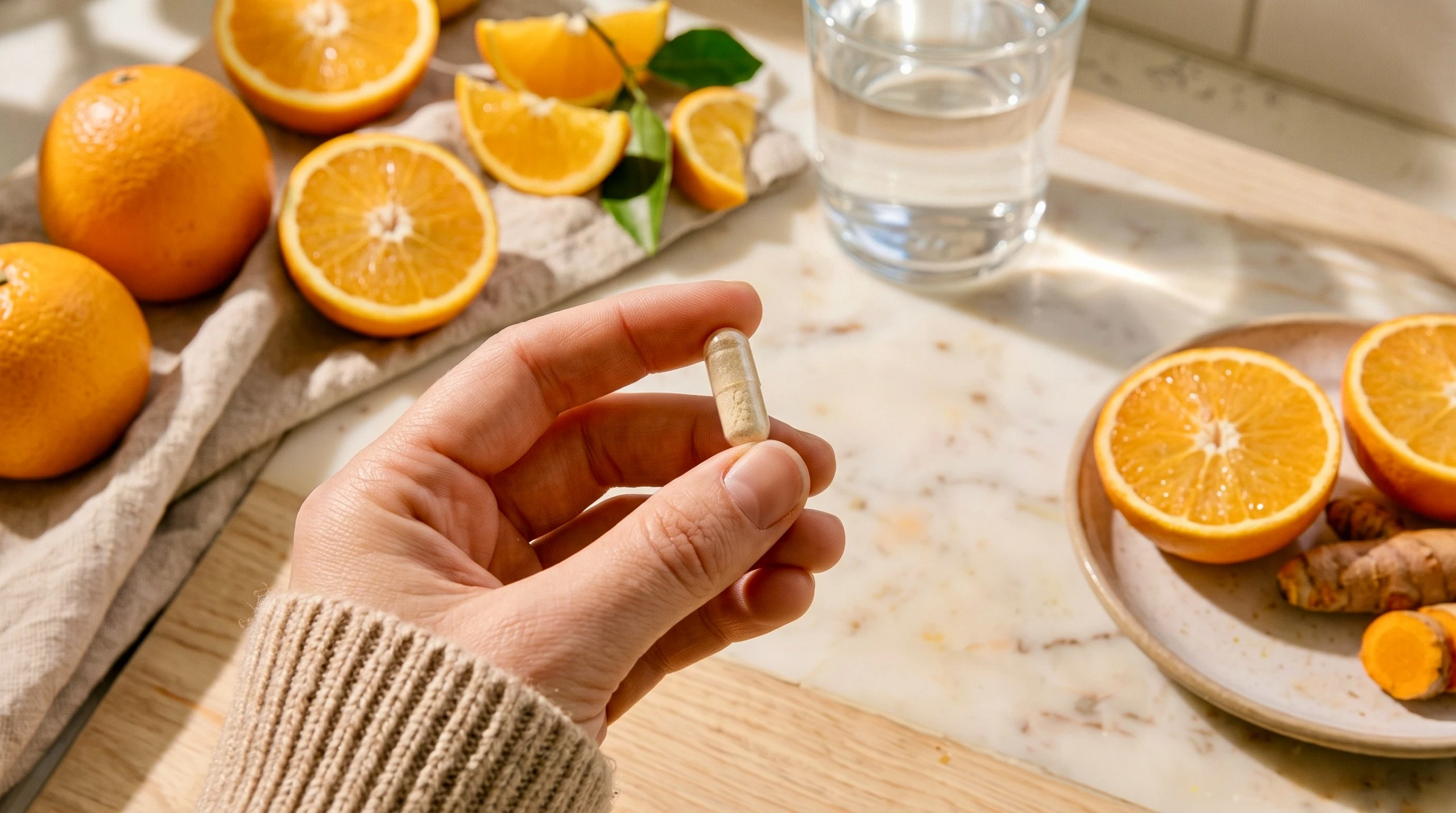
Vitamin C: The undisputed king of the category. With standard vitamin C, the rule is: the higher the single dose, the lower the percentage absorbed. Liposomal vitamin C allows you to take high doses without digestive problems and with an efficacy comparable to an intravenous infusion.
Curcumin: An exceptionally powerful anti-inflammatory antioxidant derived from turmeric, which, however, has almost zero bioavailability in its natural form. In liposomal form, its bioavailability increases by a factor of several hundred per cent.
Glutathione: Also known as the ‘mother of all antioxidants’. Normal glutathione is broken down almost immediately by enzymes in the stomach into individual amino acids, so it is practically ineffective when taken orally — liposomes are the only realistic way to get it into the cells without a needle.
Vitamins D3 and K2: Although these are fat-soluble vitamins, in liposomal form their transport to the tissues is even faster and more stable, particularly in people with fat malabsorption.
B-complex and Iron: Liposomal iron does not cause the well-known constipation or nausea, as it is absorbed via a different mechanism to ordinary iron salts.
Liposomal technology isn’t just another short-lived trend, but a clever solution to an age-old problem: how to get the maximum amount of active ingredient to where the body can actually use it. You don’t need to replace your entire home medicine cabinet with more expensive alternatives straight away. The secret lies in strategic choice – treat your body to the liposomal form when you’re feeling under the weather, going through a difficult period, or taking substances that your stomach normally struggles to absorb. After all, the most expensive vitamin is always the one that simply passes through you without doing any good. Have you had any personal experience with liposomal vitamins, or are you still sticking with traditional tablets?