















The liver in the human body works tirelessly 24 hours a day, cleansing the blood of toxins, metabolising medicines and processing fats from food. However, for this complex mechanism to function flawlessly, it needs the right building blocks. One of the absolutely most important of these is choline. Although the body can produce small amounts of it itself, without sufficient intake from the diet we run the risk of fatty liver and inflammation. Let’s take a look at exactly how choline protects the liver and why it should be a part of your daily routine.

1. Prevents liver cirrhosis
The liver processes fats from food. In order for these fats to be transported from the liver to the rest of the body, where they are used for energy, they need a ‘transporter’ called VLDL (very low-density lipoproteins). Choline is absolutely essential for the production of these transporters. If the body does not have enough choline, the fats cannot be transported out of the liver and begin to accumulate there. This leads to non-alcoholic fatty liver disease (NAFLD).
2. It supports cell growth and regeneration
Choline is the basic building block of phosphatidylcholine. It is a substance that forms a key component of cell membranes (the outer layers of cells). Thanks to sufficient levels of choline, liver cells maintain their strength and structure and are better able to regenerate in the event of damage.
3. It helps with detoxification
Choline plays a role in a biochemical process known as methylation. This process is crucial to the liver’s ability to neutralise and eliminate various toxins, metabolic waste products and medicines from the body.
4. Reduces the risk of inflammation and cirrhosis
If fat accumulates in the liver (for example, due to a long-term choline deficiency), this can, over time, lead to inflammatory processes and oxidative stress. Untreated inflammation can eventually lead to cirrhosis (permanent scarring of the liver tissue). Choline therefore helps to prevent serious damage.
Where is choline found naturally?
Although the human body is able to produce small amounts of choline itself in the liver, this amount is far from sufficient, and it is therefore necessary to obtain it from the diet or via dietary supplements.
The best natural sources of choline:
- egg yolks,
- beef liver,
- lean red meat,
- fish.
From plant sources:
- soya,
- broccoli,
- cauliflower,
-quinoa.

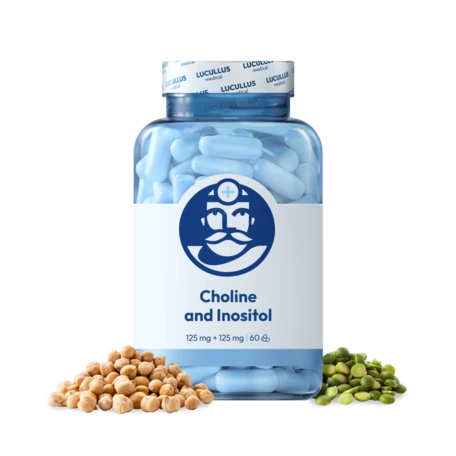
Let’s be honest, with today’s fast-paced lifestyle and lunches on the go, that’s not always realistic. If you know that your diet is sometimes a bit haphazard, a high-quality dietary supplement can act as a reliable safety net, taking care of everything carefully and simply. Of course, the rule remains that a supplement is still just a dietary supplement. Dr LUCULLUS’s premium Choline and Inositol dietary supplement is versatile in its application. Fundamentally, it supports overall liver health and aids the process of transporting fats out of the liver, thereby preventing the accumulation of fat in the liver. It also has beneficial effects on brain function and supports the nervous system.
To sum up: a healthy liver needs choline. These four benefits clearly show that, without it, our most important detoxifying organ cannot function at full capacity. The good news is that getting enough choline is no rocket science – you just need to make sure you eat a varied diet or simply top it up with a high-quality supplement. Think about your liver before it makes itself felt, and give it the nutrients it absolutely needs to function properly.